The Pledge for Inclusion
Inclusion. Awareness. Action.
#ThePurpleMovement
Towards Accessibility
This movement began with a simple question: why do so many talented people still find doors closed to them?
We realized accessibility isn’t just about ramps or signs, it’s about mindsets.
The Purple Movement is our invitation to open those doors, together.
When we include, we unlock creativity, compassion, and community. This is not just a campaign.
It’s a promise that every workplace, classroom, and website will become a place where everyone belongs.
Join us in making the world more purple — one pledge at a time.
Manya & Kimaya
The Purple Economy
The "Purple Economy" recognizes persons with disabilities not as beneficiaries of aid, but as contributors to productivity, innovation, and growth. It is an economy that thrives because it includes, not excludes.
Disability inclusion is not a favor
— it's a growth strategy.

As Workforce
Inclusive hiring unlocks diverse problem-solving, empathy, and creativity. Employees with disabilities often exhibit higher resilience, discipline, and team loyalty.

As Consumers
Globally, the disability community and their families represent nearly 3 billion consumers with $13 trillion in disposable income — an enormous, largely untapped market.

As Innovators
Persons with disabilities drive inclusive design and innovation that benefits everyone — creating better products, spaces, and experiences.
In Partnership with the Purple Economy
The Purple Movement stands alongside the Purple Economy, a global initiative that champions inclusive growth and equitable opportunity. Together, we’re shaping systems where accessibility and innovation drive sustainable progress.
The Big Picture
Why Inclusion Matters
Over 1.3 billion people globally, nearly 15% of the world's population, live with some form of disability. If this community were a nation, it would be the third-largest economy in the world, after the U.S. and China.
Yet, fewer than half of working-age persons with disabilities (PwDs) are employed. This isn't due to lack of skill or ambition, it's because of barriers built into workplaces, systems, and mindsets.


Inclusive businesses don't just 'do good' – they perform better. Research by McKinsey and Accenture shows companies with strong inclusion policies are 30% more profitable and have higher employee retention.
Only 53 of 114 countries have enacted comprehensive disability legislation aligned with the Convention on the Rights of Persons with Disabilities (CRPD). Underemployment of persons with disabilities costs up to 7% of GDP in low- and middle-income countries. Barriers persist in critical sectors like climate action, migration, and digital technology, often excluding disabled persons from key opportunities.
Accessibility is not charity. It’s good business and good humanity.

India's Moment
India has an estimated 50-80 million persons with disabilities (PwDs), with approximately 30 million considered employable. Despite progressive laws such as the Rights of Persons with Disabilities (RPwD) Act, 2016, which mandates a 4% reservation in government jobs for PwDs, only about 36% of PwDs participate in the labor force compared to 60% of non-disabled adults (National Statistical Office, 2019).
Employment for disabled women is especially low at around 23%. Over 90% of PwDs work in informal sectors like agriculture and home-based crafts, often without social security or fair wages. Accessibility remains a major hurdle, with under 25% of workplaces meeting basic accessibility standards, despite government campaigns like the Accessible India Campaign.
India is at an inflection point for disability inclusion. Bengaluru, as India's innovation capital, can become the Purple Capital, leading the country in accessible workspaces, transport, and technology.
The Barriers We Can Remove
Physical
Buildings, transport systems, and public spaces often lack ramps, elevators, or accessible restrooms.
Digital
Websites and apps that ignore accessibility standards exclude millions of users who rely on screen readers, captions, or voice navigation.
Structural
Many organizations lack policies or budgets for reasonable accommodations, simple measures that can transform workplace participation.
Attitudinal
Stereotypes and unconscious bias often prevent people with disabilities from being seen as capable professionals.
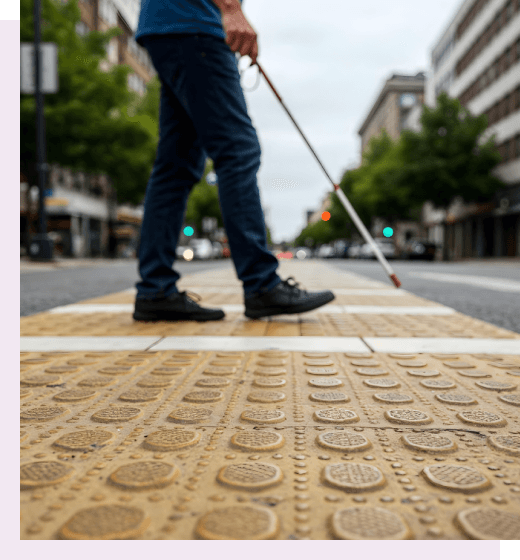
Each barrier removed doesn't just help a few — it liberates potential for all.


The Purple Pledge:
A Commitment to Inclusion
The Purple Pledge is a simple, actionable commitment by individuals and organizations to make their spaces, physical, digital, and cultural, more accessible for everyone. It's not about audits or certification. It's about awareness, empathy, and intent.
The Pledge Principles
Empathy before infrastructure
We will see accessibility as dignity, not charity.
Access for all
We will ensure our spaces and systems work for everyone.
Voice and Visibility
We will include persons with disabilities in decisions that affect them
Learning Mindset
We will train, sensitize, and continuously evolve.
Public Commitment
We will display our pledge and inspire others to follow.
Empathy before infrastructure
We will see accessibility as dignity, not charity.
The World We Imagine
A world where every door opens — for everyone. The Purple Movement is not a campaign. It's a promise — that accessibility will become a way of life, not an afterthought. Together, we can make inclusion visible and create a society that truly leaves no one behind.
Inclusive companies outperform their peers in every dimension of success — innovation, loyalty, brand reputation, and profitability. Accessibility drives value and aligns perfectly with ESG and CSR priorities.
Innovation:
Microsoft, Unilever, and SAP have inclusive design labs that serve all consumers.
Productivity:
Accessible environments reduce friction for everyone.
Reputation:
Inclusion builds trust and customer preference.
Compliance:
India's Rights of Persons with Disabilities Act (2016) mandates inclusion.

FACES OF INCLUSION
Meera’s Story
Hospitality Sector
Meera lost her vision at 19. Today, she leads guest relations at Lemon Tree Hotels, proof that empathy and training can redefine service excellence.
The Purple Rating Framework
To build accountability and recognition, the Purple Rating offers a measurable way to assess workplace inclusion.
Six Core Dimensions:

Physical Accessibility

Assistive Technology & Tools

HR & Policy Inclusion

Awareness & Culture

Emergency & Safety Readiness

Feedback & Continuous Improvement
Rating Levels:
Unrated (<25).The Purple Circle
A Community of Practice
The Purple Circle is a network of pledge-taking organizations that meet quarterly to share ideas, learn from one another, and celebrate progress. Joining the Circle means joining a community of leaders who believe accessibility builds stronger businesses and better societies.

Take the Purple Pledge Today
Every ramp built, every caption added, every job opened, makes the world a little more purple.

Corporates
Commit to accessible design, hiring, and culture.

Institutions
Make your campus inclusive and welcoming.

Individuals
Be accessibility advocates in your daily life.
Corporates
Commit to accessible design, hiring, and culture.
Institutions
Make your campus inclusive and welcoming.
Individuals
Be accessibility advocates in your daily life.